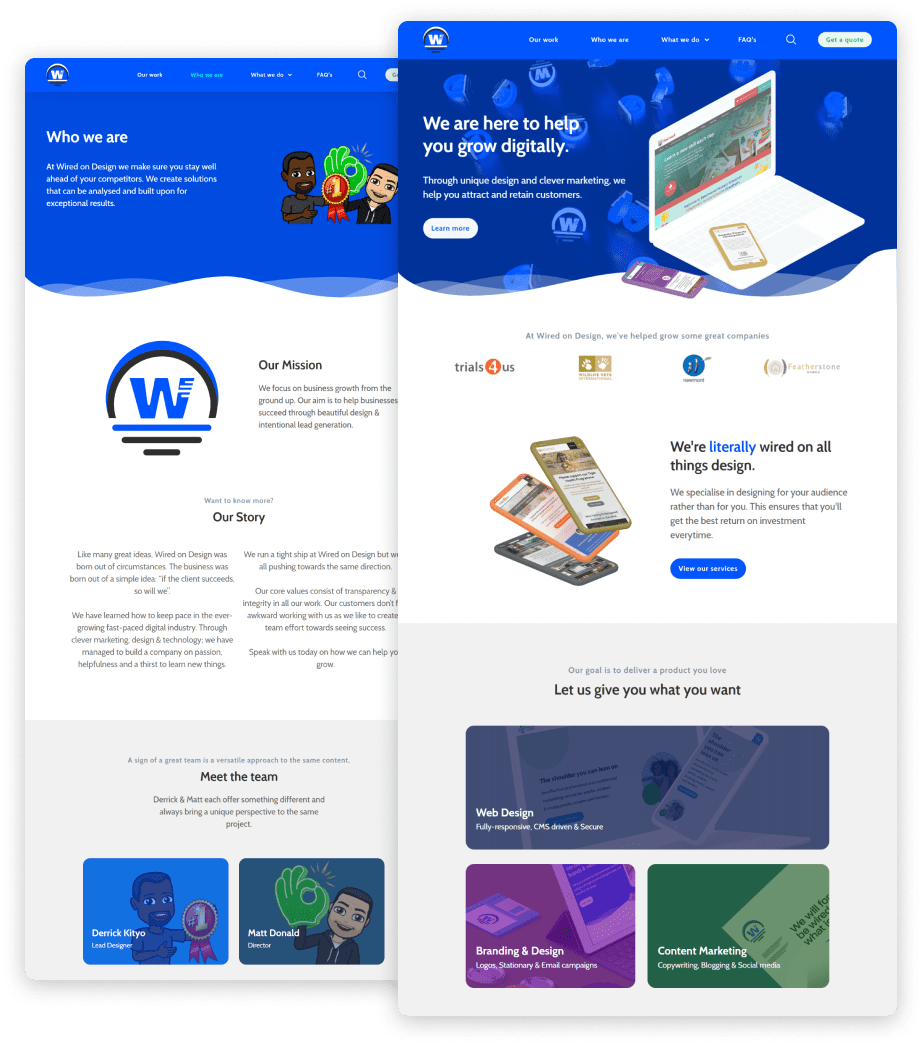
Wired on Design is a web design agency where I worked as Lead Designer and Developer for five years after graduating. It's where I learned Webflow, transitioned away from WordPress, and discovered the platform's value for fast, design-led marketing sites.
Through a series of trial and error with WordPress-based websites, I gradually adopted Webflow in my own time and migrated more than 20 client sites across to the platform. The transition unlocked significant gains in build speed, client editing autonomy, and design fidelity.
Beyond client work, I designed the Wired on Design brand and built the agency's own Webflow website. Rapid design and smooth user experiences became the core deliverables across nearly every project.
β
When I joined Wired on Design as Lead Designer and Developer, the agency was built on WordPress. That meant every project involved the same friction: themes that fought against design decisions, plugins that needed constant updating, client sites that broke when something in the stack shifted, and a build velocity that limited how much design attention each project could actually receive.
The agency's own brand and website had not been refreshed in years, which created an obvious disconnect. We were pitching design-led work to clients from a site that did not demonstrate design capability. The WordPress dependency was holding back both the quality of our client work and the credibility of our own brand. Every project involved a negotiation between what the design needed and what WordPress would allow.
There was also a client autonomy problem. After we delivered a WordPress site, clients would come back for every small content change, every new page, every image update. Those requests clogged the pipeline and consumed developer time that should have been going into new projects. The agency needed a platform that would give clients genuine editing independence while preserving design quality.
Over five years, I systematically transitioned more than 20 client sites from WordPress to Webflow, learning the platform on my own time and proving its value project by project. Each migration unlocked immediate gains: build speed improved dramatically because I was not fighting a theme, design fidelity went up because Webflow gives pixel-level control without writing custom CSS for everything, and clients gained editing autonomy through the Webflow Editor that they never had with the WordPress admin panel.
I also designed the Wired on Design brand from scratch and built the agency's own Webflow website, creating a digital presence that actually demonstrated the quality of work we were pitching. The new agency site became both a portfolio piece and a lead generation tool, with the design and build quality doing much of the selling before a proposal ever went out. Rapid design and smooth user experiences became the core deliverables across nearly every project.
The transition was gradual and deliberate. I started with smaller projects to build confidence in the platform, then moved to more complex builds as my Webflow expertise deepened. By the end, we had a repeatable workflow, a library of reusable components, and a design-to-build pipeline that was dramatically faster and more reliable than anything we had achieved on WordPress.
The WordPress-to-Webflow transition fundamentally changed how Wired on Design operated. Build speed improvements meant we could take on more projects or invest more design time in each one, which directly improved the quality of client outcomes. Client editing autonomy reduced the volume of small-change requests that used to clog the pipeline, freeing up developer time for actual development work.
The agency's own Webflow site served as a living case study: clients could see exactly what Webflow was capable of before committing to a build. That shortened sales cycles and raised the quality of conversations, because prospects arrived already understanding what the platform could deliver.
For me personally, those five years of transition work built the Webflow expertise and the project workflow discipline that now defines how I approach every client engagement. Wired on Design is where I learned that the right platform does not just make projects easier; it changes what is possible.