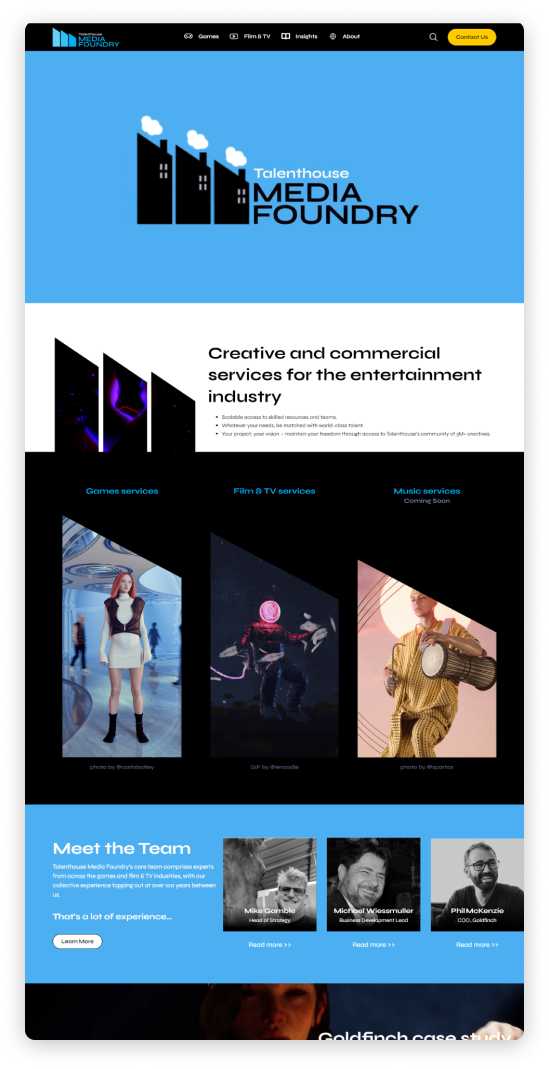
Media Foundry aims to be the de-facto platform for entertainment creatives across all verticals, helping them build and take their projects to market while retaining creative control and company independence. I worked with Media Foundry, part of Talenthouse, to design and build a news-style Webflow website that showcases the platform's offering to the entertainment creative community.
The Webflow build features editorial-style layouts that support feature stories, creator profiles, and platform-driven content, with a Webflow CMS structured for ongoing editorial publishing. The design balances the platform's commercial messaging with content-led storytelling appropriate to its creative audience.
The result is a Webflow website that positions Media Foundry as a credible operator in the entertainment platform space, with the editorial flexibility to scale alongside the platform's evolving offering and creator partnerships.
β
Media Foundry was entering a crowded space: the intersection of creative platforms, entertainment industry networks, and commercial marketplace tools. Their value proposition was genuinely different, giving creatives a way to retain control and independence while accessing the resources to bring projects to market. But in the entertainment industry, credibility is earned through demonstrated understanding of the community, not claimed through positioning statements.
The platform needed a digital presence that spoke fluently to creative professionals. A generic SaaS site selling to content creators in the abstract would not land. The audience Media Foundry needed to attract can spot corporate language at a hundred paces, and they treat it as a signal that a platform does not actually understand their world. The challenge was balancing commercial messaging with the editorial, story-driven tone that creative professionals respond to.
There was also a content strategy question. Media Foundry needed to publish feature stories, creator profiles, and platform updates regularly to build credibility over time. The site had to function as an ongoing publication, not just a launch-day brochure. That required a CMS architecture that could support editorial velocity without developer involvement.
I designed and built a news-style Webflow website that leads with storytelling rather than features. The editorial layouts support feature stories, creator profiles, and platform-driven content, with the Webflow CMS structured so the Media Foundry team can publish ongoing editorial without developer support. Each content type gets its own templated presentation, giving the editorial team flexibility to tell different kinds of stories as the platform's creator partnerships expand.
The design balances commercial messaging with content-led storytelling, using typography and layout treatments that feel closer to an independent publication than a corporate platform. I paid particular attention to the reading experience: type scale, line length, and content hierarchy are tuned for long-form editorial consumption, which is how creative professionals engage with industry content.
The CMS architecture supports multiple content types including articles, profiles, and case studies, each with distinct templating that serves the content rather than forcing everything into a single format. This flexibility matters because a creator profile, an industry feature, and a platform announcement all need different presentation approaches to work effectively.
Media Foundry launched with a digital presence that positions them as a credible operator in the entertainment platform space rather than just another startup with a pitch deck. The editorial-first approach gives the platform a reason to exist in the daily browsing habits of their target creative audience, while the commercial messaging sits naturally alongside the content rather than competing with it.
The CMS gives the team the editorial flexibility to scale content production as the platform grows, with the Webflow build providing a stable foundation that can accommodate new content types and partnership announcements without needing redesigns. The site works as both a credibility builder and a conversion tool, with editorial content creating the trust that makes the commercial messaging effective.
For the creative professionals Media Foundry aims to serve, the site feels like it was built by people who understand their industry. That is a harder design outcome to measure than conversion rates, but in a community where authenticity is the primary currency, it is the one that actually matters.