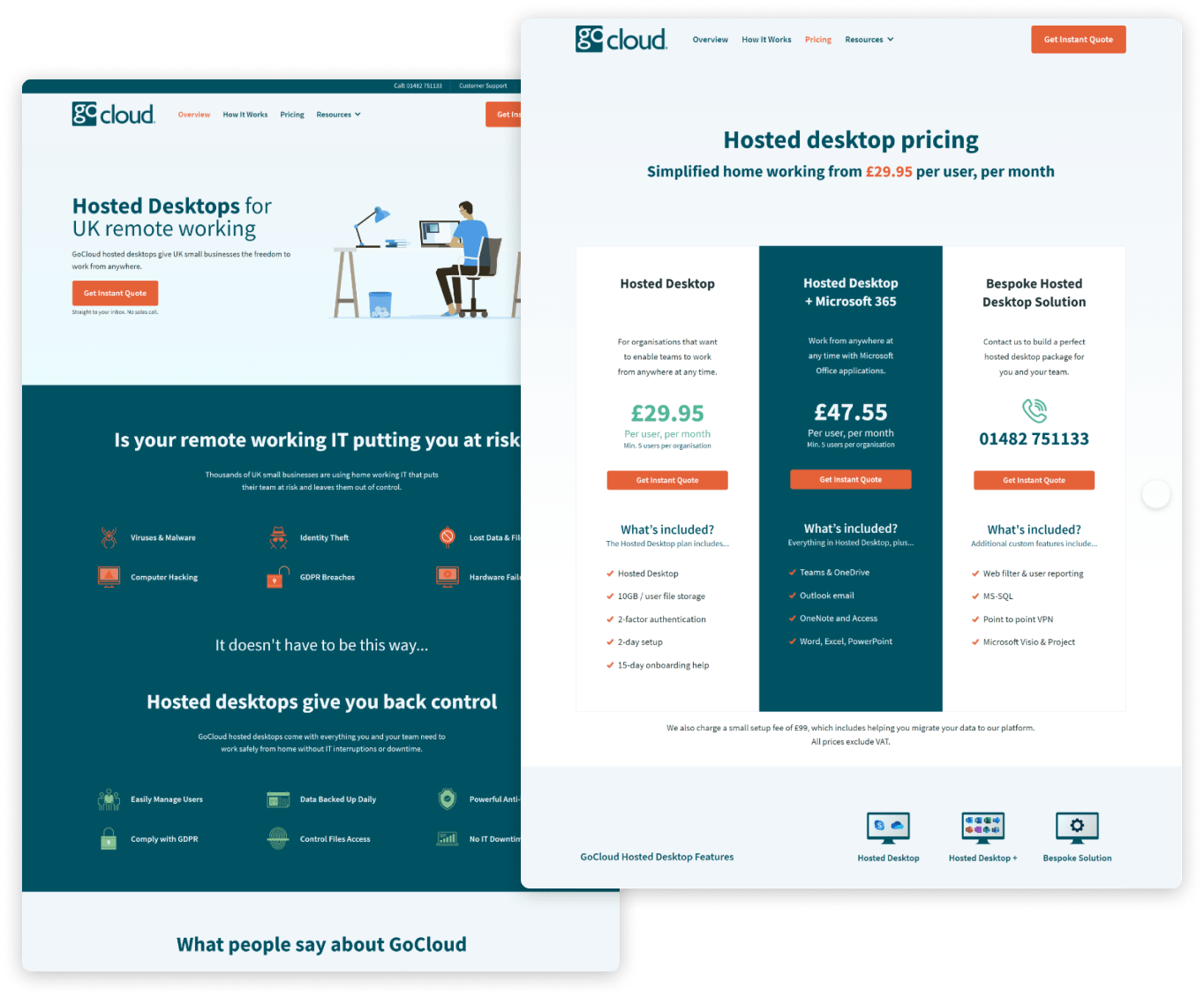
GoCloud provides hosted desktops for remote companies across the UK, giving small businesses the freedom to work from anywhere. I was commissioned by Ignite Marketing to design and build a new Webflow marketing site for GoCloud that integrates with their Mailchimp mailing lists for lead capture and automated nurture.
I built a Webflow design system to support easy addition of new pages, then translated the supplied Figma designs into a fast, responsive Webflow build. Several illustrations were customised to incorporate the GoCloud brand and add colour-led visual touches.
Custom code connects the site's lead capture forms directly into Mailchimp through an API integration, giving the Ignite Marketing team a clean data flow from website signups into ongoing marketing campaigns.
β
GoCloud had a solid product: hosted desktops that let UK small businesses give their teams secure, consistent access to work environments from anywhere. But their marketing site was not converting. The value proposition was buried in technical descriptions of infrastructure and specifications, when what small business owners actually needed to hear was straightforward: you can work from anywhere, your data stays secure, and you do not need an IT department to set it up.
The site also had a lead capture problem. Signups were going into a generic inbox instead of flowing directly into the Mailchimp nurture sequences that Ignite Marketing had designed to convert leads into customers. Every signup that landed in a generic inbox was a lead that required manual processing, which meant delays, data entry errors, and missed follow-up opportunities.
For a cloud services company, the irony was not lost on anyone: their own digital infrastructure was creating manual work that their product was designed to eliminate. The marketing site needed to demonstrate the efficiency that GoCloud was selling, not undermine it.
I built the new Webflow marketing site from Figma designs supplied by Ignite Marketing, creating a Webflow design system that makes it easy to add new pages as the marketing strategy evolves. I customised several of the supplied illustrations to incorporate GoCloud's brand colours and add visual consistency across the site, ensuring the brand feels cohesive rather than patched together.
The lead capture forms connect directly into Mailchimp through a custom API integration, so every signup flows automatically into the right nurture sequence without manual export or data entry. This closed the gap between website and marketing operations that had been costing leads. The build emphasises speed and clarity, with the value proposition front and centre and the technical details available for buyers who want to go deeper.
Responsive behaviour was tested across device sizes to make sure the site performs well on mobile, where a significant portion of small business owners will first encounter it. The Webflow design system I established means the Ignite Marketing team can spin up new landing pages and campaign microsites without starting from scratch, preserving design consistency while enabling marketing velocity.
GoCloud's marketing site now converts visitors into nurtured leads without manual intervention. The Mailchimp integration gives the Ignite Marketing team a clean data pipeline from website signups into their campaigns, which means they can measure performance and optimise sequences based on real data rather than estimates.
The Webflow design system means new landing pages and campaign microsites can be built quickly without starting from scratch each time. For GoCloud's target customers, the site communicates the freedom and simplicity of hosted desktops in terms that actually make sense to a small business owner who just wants their team to be able to work securely from anywhere.
The marketing site finally matches the quality of the product it is selling. For a company whose whole value proposition is eliminating IT headaches, having a website that runs smoothly, captures leads automatically, and updates easily is not just good marketing; it is proof of concept.