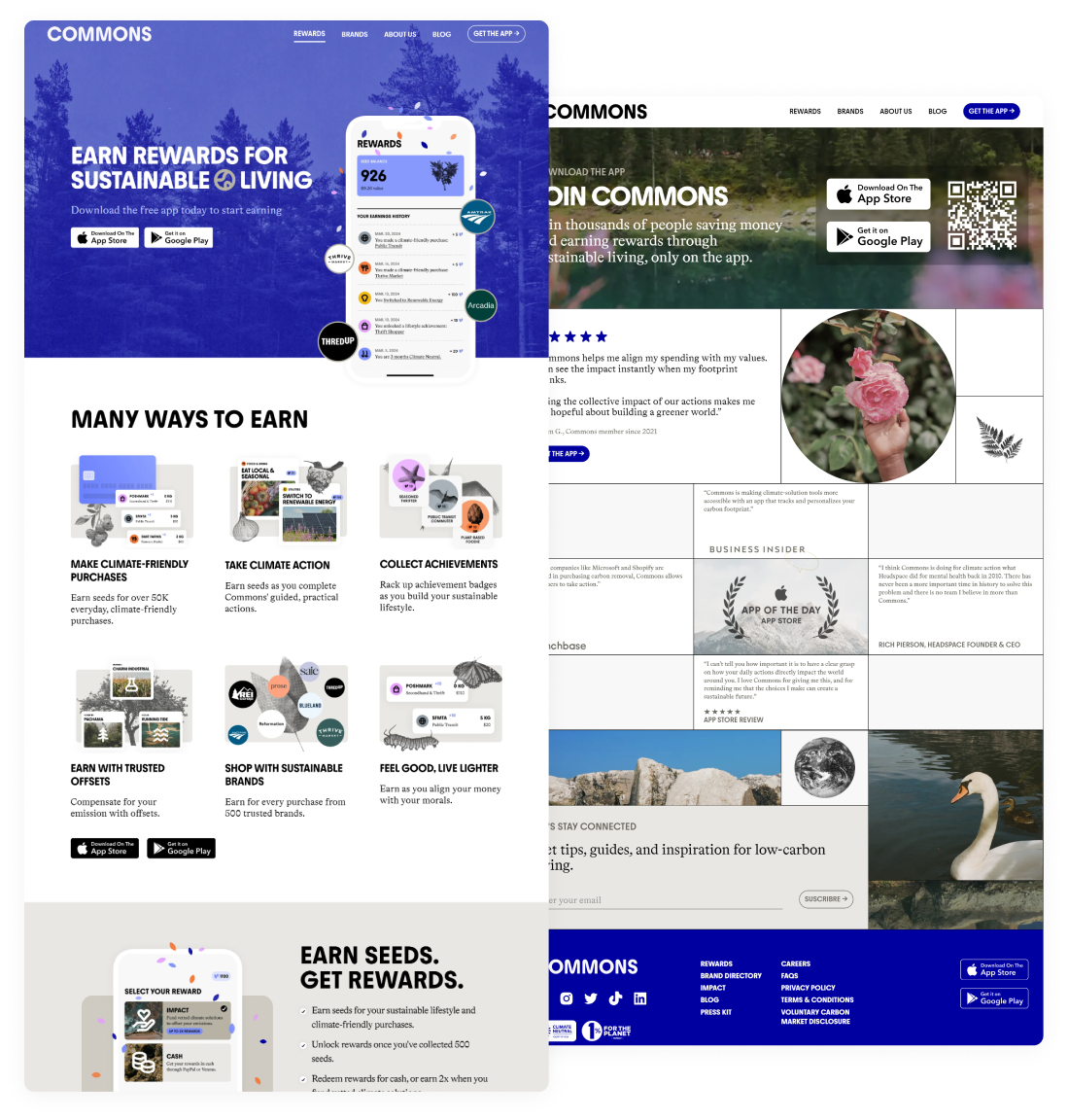
Commons.earth is a community-driven climate action platform that equips users with tools to understand and minimise their carbon footprint. The app offers personalised insights, actionable tips, and guides aimed at fostering sustainable lifestyle choices, much like Headspace has popularised mental wellness at scale.
I designed and built the Commons.earth marketing website in Webflow, focused on translating the app's core functionality and community spirit into a compelling digital presence. The site communicates how users can engage with features like carbon tracking, earning rewards for sustainable actions, and funding climate solutions.
The Webflow site integrates seamlessly with the Commons.earth app, providing a portal for new and existing users to explore additional resources and join the community. The Webflow CMS supports ongoing content updates, and I continue to enhance user experience and add new features as the platform evolves.
Commons Earth came to me with a challenge that many climate organisations face: how do you present complex environmental data in a way that actually moves people to action? Their existing site was a mix of dense reports, academic language, and donation pages that felt disconnected from the on-the-ground work they were funding. Visitors bounced because they couldn't quickly understand what Commons Earth did or why it mattered.
The organisation was also preparing to pitch institutional funders — and they knew their digital presence would be scrutinised. A climate action platform asking for serious money needs a site that communicates rigour, transparency, and impact. The old site communicated none of those things convincingly.
I designed a narrative-first Webflow site that turns environmental data into stories. The homepage uses a scrolling impact timeline — each scroll section pairs a key climate metric with the corresponding Commons Earth project, connecting the abstract (carbon tonnes, hectares protected) to the concrete (the communities and ecosystems affected). Visual hierarchy does the heavy lifting: data visualisations sit alongside project photography so the numbers always have a human context.
The project directory was the most technically involved piece. Each funded initiative gets a structured CMS page with location mapping, funding stages, impact metrics with progress bars, and partner attribution. I built the CMS schema so the team can add new projects with standardised data fields — the design layer handles rendering consistently regardless of which fields are populated.
A custom corporate-style-guide system ensures every page, template, and CMS-collection item stays on-brand as the team scales their content. I also built the site with a component-based architecture that lets Commons Earth repurpose sections (the impact timeline, the project cards, the funding progress module) across different campaigns without rebuilding.
Commons Earth now has a site that does what their mission demands: it takes complex climate science and makes it legible, urgent, and actionable. The impact timeline has become their primary fundraising tool — it's the page they send to institutional donors and the one that gets shared most on social media.
Operationally, the CMS has cut their content publishing cycle from days to hours. A new project goes from funded to live on the site in under 30 minutes, with consistent branding, accurate data, and proper attribution — all handled by the communications team without developer involvement.
For me, this project demonstrated something important about Webflow's potential for mission-driven organisations: when you pair a thoughtful information architecture with a genuinely usable CMS, you don't just get a website — you get a fundraising engine that scales with the organisation's ambition.