The carbon credit market has a credibility crisis that threatens its entire reason for existing.
Buyers, from corporate sustainability teams managing net-zero commitments to individual investors seeking climate impact, struggle to distinguish between carbon projects that genuinely sequester carbon and those that overstate their impact.
Without transparent, scientifically rigorous ratings, the market risks losing trust with the very stakeholders whose capital is essential to scaling nature-based climate solutions. The problem is not that good projects don't exist; it's that buyers can't reliably tell which ones are good.
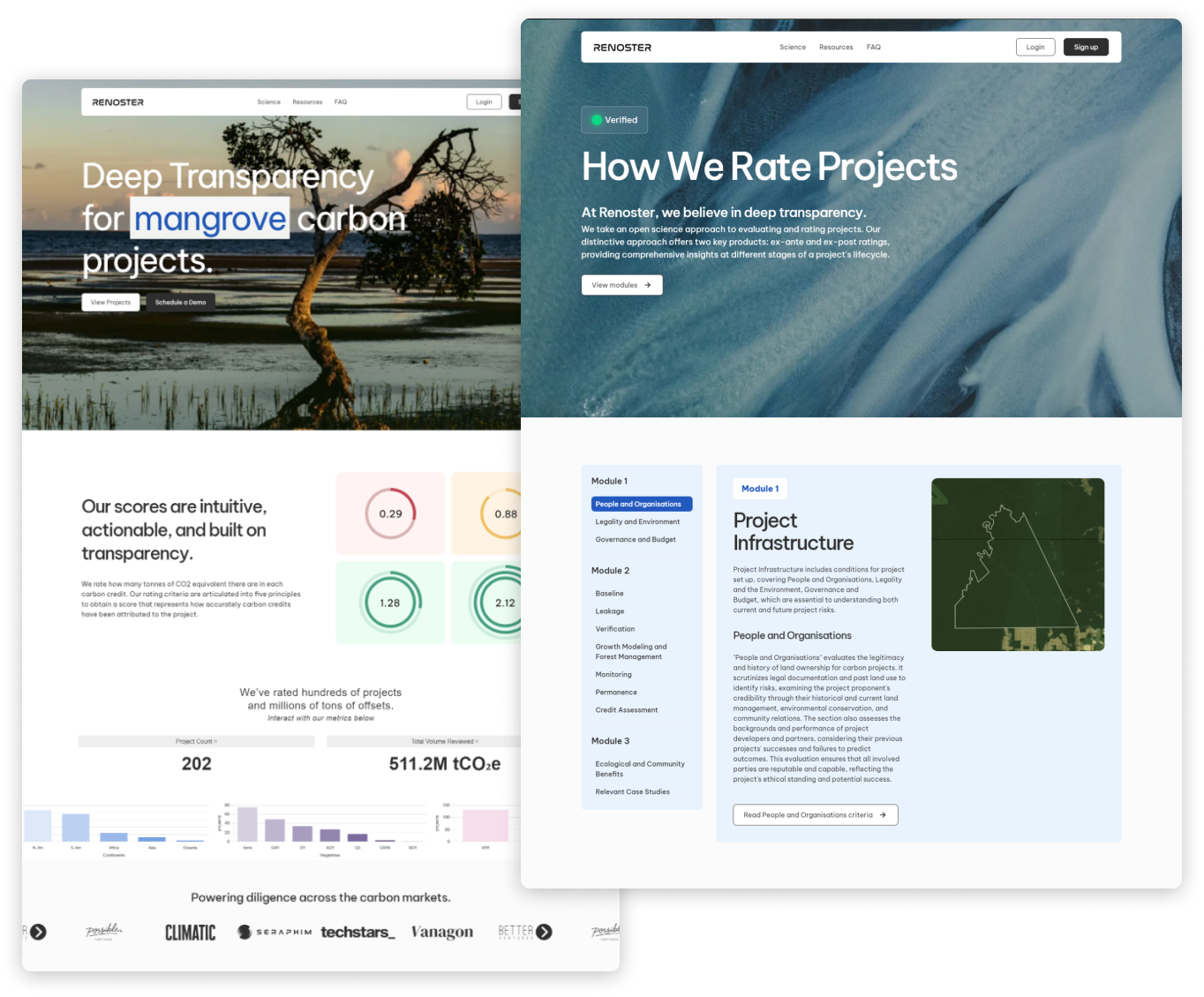
Renoster had developed a genuinely rigorous methodology for rating rainforest carbon projects, grounded in remote sensing, ecological science, and transparent scoring that makes the evidence behind each rating visible and auditable. But their website was essentially an academic placeholder.
It didn't communicate the depth of their science, the usability of their ratings, or the urgency of what they were building for carbon markets at a moment when the world is watching.
The stakes were higher than a typical SaaS marketing site. Renoster's credibility depends entirely on being perceived as scientifically authoritative rather than marketing-driven. Every design decision had to reinforce precision, transparency, and rigour.
A site that looked like a slick startup would undermine the very trust Renoster needed to build. But a site that looked like a research paper would fail to engage the buyers who need to use these ratings to make decisions.

 Attributes
 Client First
 Relume Styleguide