High-Trust Web Design for Professional Services That Wins Clients
%20(1).avif) Written by Derrick Kityo
Written by Derrick KityoDiscover how strategic web design for professional services builds authority and drives client acquisition. A practical guide for UK firms using Webflow.

If you’re a law firm, a consultancy, or a financial advisor, your website is so much more than a digital brochure. It’s your first handshake . It’s your number one sales tool . And it’s your most persistent business developer, working 24/7 to bring in and qualify potential clients. A great site doesn't just look good; it communicates deep expertise and builds the critical trust needed for high-stakes decisions.
Why Your Website Is Your Hardest Working Business Developer
In the world of professional services, a generic, template-based website is a major liability. It completely fails to communicate the nuanced value you bring to the table and can actively damage your credibility before you ever get a chance to speak with a prospect.
Think about it: a staggering 73% of consumers say they trust a business more if it has a professional-looking website. For any business built on authority and trust, that’s not just a nice-to-have statistic—it’s everything.
Your website isn’t some passive online placeholder. It's the central hub of your entire client acquisition strategy. It’s the first place a referral goes to check you out, and it’s where a complete stranger decides if you’re even worth their time.
Communicating Complex Value Propositions
Unlike an e-commerce store, you're not selling a simple, tangible product. You’re selling expertise, strategic guidance, and outcomes that are often complex and hard to pin down. A properly executed website for a professional service tackles this challenge head-on.
- Making Expertise Tangible: It uses crystal-clear messaging, insightful articles, and detailed case studies to make your abstract services feel concrete and real.
- Speaking to Different Audiences: It guides different types of visitors—say, a corporate client versus a private individual—to the exact information that matters to them .
- Detailing Your Process: It shows potential clients how you solve their problems, which demystifies your services and builds their confidence in your approach.
Turning Scepticism into Opportunity
Let's be honest, prospective clients in our world are naturally cautious. They’re discerning, and they’re actively looking for reasons to disqualify you. Your website's job is to give them every reason to trust you instead.
This is about more than just slick visuals. The site needs to be a strategic asset.
A great website pre-sells your value long before you ever speak to a lead. It answers their initial questions, addresses their underlying concerns, and frames your firm as the only logical solution to their problem.
This is exactly where a platform like Webflow shines. It gives you the design freedom to create a truly unique and credible digital presence, steering clear of that cookie-cutter feel you get from common templates. By combining strategic messaging with a seamless user experience, your website transforms from a passive brochure into an active, lead-generating machine.
It truly becomes your hardest-working team member, tirelessly making your case to the world.
Building Your Strategic Website Blueprint
A great website for a professional service firm isn't something you just knock out in a design tool. It’s carefully planned, built on a deep understanding of your ideal client. Before you even think about colours or fonts, you need a strategic blueprint. This early stage is all about asking the right questions to make sure the final website isn't just a pretty face, but a machine built to convert.
It all kicks off with getting crystal clear on your ideal client profiles. I’m not just talking about basic demographics; you need to dig into their psychographics. What are their biggest headaches at work? What specific results are they hoping for when they start looking for a service like yours? When you get these core motivations, you can shape every single element of your site to speak directly to them.
At the same time, you've got to size up the competition. Don't just glance at their branding—really pull apart their website's user experience. Pinpoint what they're doing well, and more importantly, where they’re dropping the ball. This is often where you'll find golden opportunities to position your unique value and make it shine.
Mapping the User Journey
With these insights in hand, you can start mapping out the website’s structure. We’re not designing yet; this is all about logic and flow. The aim is to create an information architecture—a sitemap—that guides visitors smoothly to what they need, and ultimately, gets them to pick up the phone or fill out a form.
A huge part of your blueprint has to be user experience, which underlines the importance of a user-friendly website . It’s about organising your content so intuitively that a potential client never feels lost or confused.
Think about the main journeys different visitors might take:
- The Referral: This person already knows your name and just wants to quickly confirm you’re the real deal. They need to find case studies, team bios, and clear service descriptions, fast.
- The Researcher: They know they have a problem but are still exploring their options. They’re hunting for insightful blog posts, downloadable guides, and detailed breakdowns of your process.
- The Ready-to-Buy Lead: They’ve decided they need help and are now comparing providers. For them, it's all about finding pricing, contact details, and a clear call-to-action like "Book a Consultation."
This flow shows how a website evolves from a simple online brochure into a real business development tool.
It really highlights that shift from just passively showing information to actively engaging prospects and automating those first steps of the client relationship.
From Sitemap to Wireframe
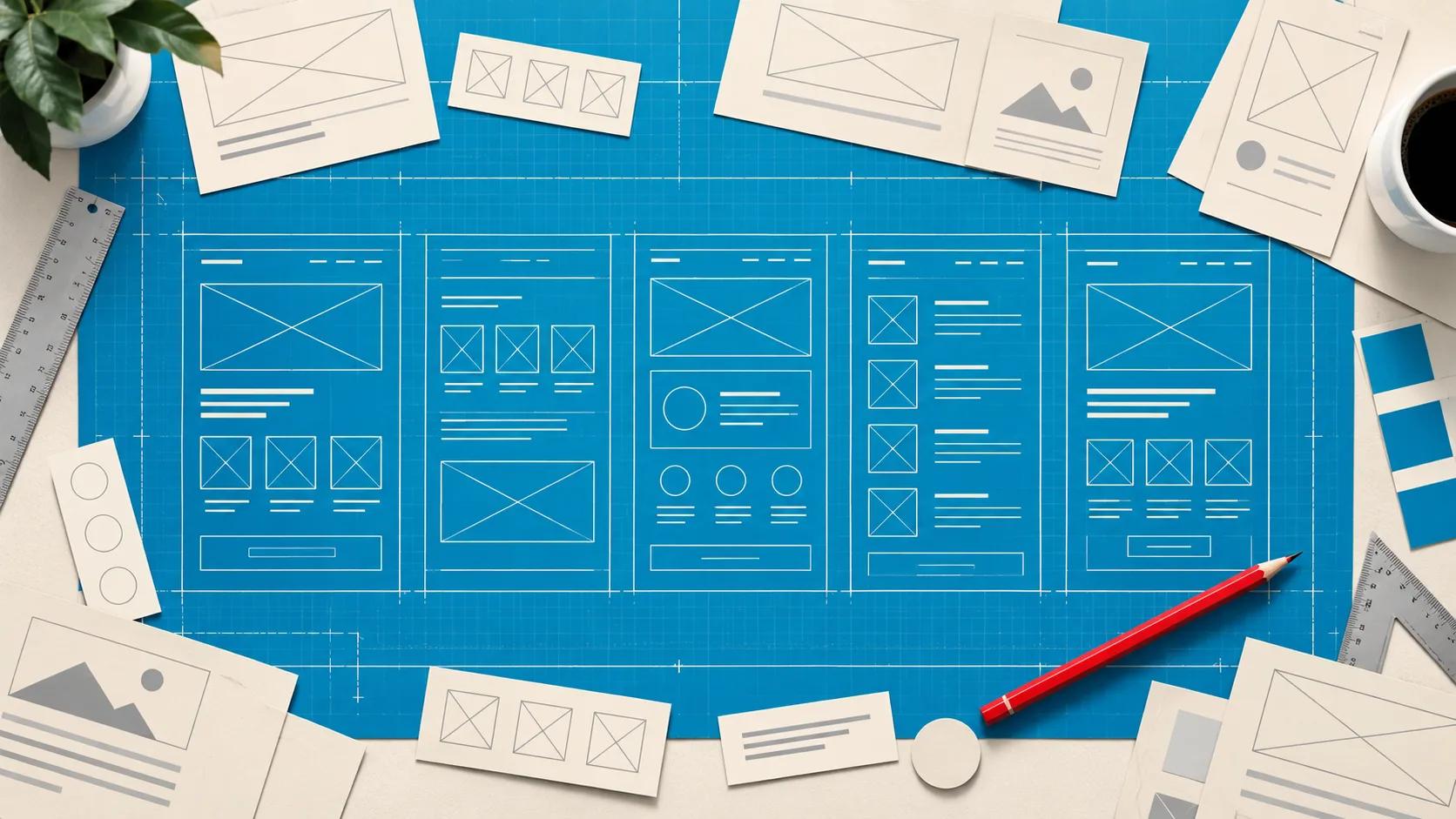
Once you've locked in your sitemap, the next logical step is to create a wireframe. Think of a wireframe as a low-fidelity skeleton of your website's main pages. It's purely about structure, layout, and where the content will go, deliberately stripping out all the distracting visuals like colour, fonts, and images for now.
By focusing on the structure first, you make sure the user experience is rock-solid before any visual design decisions muddy the waters. This strategic thinking saves you from expensive redesigns down the line and keeps the project laser-focused on what really matters: generating qualified leads.
This kind of structural planning is absolutely non-negotiable for successful web design for professional services . To get a better handle on this critical step, you can learn more about https://www.derrick.dk/post/creating-a-wireframe and how it maps out your user journeys. This blueprint ensures every page has a clear purpose, building visitor confidence with every click and setting the stage for a website built on strategy, not just guesswork.
Designing for Unshakable Trust and Authority
For any professional service—be it a law firm or a consultancy—your website is far more than a digital brochure. It’s a direct reflection of your credibility. Potential clients are making snap judgements in seconds, and a polished, authoritative design is your first and best chance to communicate that you're a serious, expert-led firm.
This goes way beyond picking a “professional” colour palette. The visual choices you make—your typography, imagery, and layout—all work together to create an immediate feeling of trust. A clean, legible serif font for headings, for example, can suggest tradition and authority, which is perfect for a law firm. On the other hand, a modern sans-serif might project innovation and forward-thinking, a better fit for a tech consultancy.
Every single choice needs to align with the brand you want to project. To get a better handle on this, you can explore our deep dive into the core elements of visual design and see how these components build a cohesive story.
Weaving in Powerful Trust Signals
While great design sets the stage, it’s the tangible proof of your expertise that truly wins over discerning clients. I’m talking about trust signals —the undeniable evidence that you deliver on your promises. Good web design for professional services is all about strategically embedding these signals throughout your site, not just hiding them on one page.
Forget the old-school "Testimonials" page. Instead, place powerful quotes right on the service pages where they’ll have the most impact. Show, don't just tell.
Some of the most effective trust signals include:
- Detailed Case Studies: Don't just give a project summary. You need to outline the client's initial problem, walk through your strategic process, and—most importantly—showcase the measurable results you delivered. Webflow 's CMS is brilliant for this, making it simple to create filterable case study galleries.
- Authentic Testimonials: A video testimonial or a quote with the client's full name, title, and headshot carries so much more weight than an anonymous snippet of praise.
- Industry Credentials and Awards: Get those logos up! Displaying well-known clients, industry awards, or key certifications is instant social proof. The footer or homepage is a great spot for these.
- Transparent Team Bios: Show the real people behind the firm. High-quality headshots and bios that detail each person's specific expertise make your business feel more human and approachable.
To really nail this, think about what a potential client is worried about and match a trust signal to that concern.
Essential Trust Signals for Professional Service Websites
Here’s a breakdown of the key elements that build credibility and the specific client concerns they help to overcome.
By weaving these elements throughout your site, you move from simply stating your value to actively proving it at every turn.
The Impact of a Professional Digital Presence
For firms where credibility is everything, a subpar digital presence isn't just an eyesore—it's a massive liability. The UK alone has over 2.7 million active websites, creating fierce competition. A professionally designed site directly boosts your standing; in fact, 81% of consumers say a brand’s trustworthiness is tied to the quality of its website.
The goal isn't just to list your accomplishments; it's to create a compelling narrative of success. Your website should tell a story where the client is the hero, and your firm is the expert guide that leads them to a successful outcome.
When you thoughtfully combine a sophisticated visual design with concrete evidence of your expertise, you build a digital presence that doesn't just attract visitors. It converts them into high-value clients who already trust you before you've even had the first conversation.
Turning Website Visitors Into Qualified Leads
A visually stunning website is only half the battle. For any professional service firm, the real test is how well it turns anonymous visitors into actual, qualified leads. This is where sharp user experience (UX) and rock-solid technical performance come together, shifting your site from a digital brochure into a proper client-generation engine.
The whole game hinges on making it ridiculously easy for a potential client to take that next step. This means placing clear, compelling calls-to-action (CTAs) exactly where they’re needed most. A prominent "Book a Consultation" button in your site's header is a great start, but real effectiveness comes from context.
For example, after a detailed case study, the logical next step for the reader isn't a generic "Contact Us." It's something like, "See How We Can Achieve Similar Results for You." A service page should guide users straight to a relevant contact form. The idea is to create a frictionless journey that feels natural and helpful, not pushy.
Optimising for Performance and Visibility
But here's the thing: even the most persuasive CTA is useless if your website's technical performance lets you down. In the professional services world, site speed is a direct reflection of your credibility. A slow, clunky website sends a subconscious signal that your firm is outdated or doesn't sweat the details—a fatal impression when high-value contracts are on the table.
This is a huge reason why a clean, professional Webflow build has such an edge. Unlike bloated, template-based platforms, Webflow produces lean code that search engines love, which translates directly to faster loading times and better performance. This technical excellence isn't just a "nice-to-have" anymore; it's a core component of effective web design for professional services . To dig deeper into converting visitors, check out this guide on mastering online lead generation.
Actionable On-Page SEO for Professional Services
Getting found by the right people on Google is critical. You don’t need to be an SEO wizard, but you absolutely have to get the fundamentals right. Start by thinking about the specific problems your ideal clients are trying to solve, then create content that answers those questions directly.
Here are a few on-page SEO essentials to nail:
- Keyword-Focused Page Titles: Make sure every page has a unique title that includes its primary keyword (e.g., "Financial Advisory Services for London Startups").
- Compelling Meta Descriptions: Write short, engaging summaries (around 155 characters ) for each page. Think of them as mini-adverts that encourage people to click through from search results.
- Logical Heading Structure: Use headings (H1, H2, H3) to organise your content. This not only helps users scan the page but also shows search engines the hierarchy of your information.
- Descriptive Image Alt Text: Give every image a brief, descriptive text. This is crucial for accessibility and gives search engines more context about your page.
A well-optimised website doesn't just attract more traffic; it attracts the right traffic. By aligning your content with what your ideal clients are searching for, you ensure that the leads you generate are far more likely to be a perfect fit for your firm.
In the current economic climate, UK businesses are being more discerning with their investments, and a website redesign is high on their list. In fact, 69% of businesses are prioritising redesigns in their 2025 budgets, knowing that 94% of first impressions are driven by design. This is especially true for consultancies and healthcare providers where trust is everything. With slow sites causing a 41% abandonment rate , performance has become non-negotiable.
This is exactly where a high-performing site, paired with persuasive messaging, makes a huge commercial impact. Of course, a big part of that is having the right words on the page. You can find more guidance on crafting compelling copy for your website in our related article.
Want to apply this to your own website or app?
Tell me what you are working on and where it is getting stuck. I will help you turn the useful ideas into shipped work.
Launching and Evolving Your Digital Presence
Getting your new website live isn't the finish line; it’s the starting pistol. A successful launch is a carefully managed process, not just a flip of a switch. You need a meticulous pre-flight check to make sure every last detail is primed for performance from the moment you go live.
Before you even think about pointing your domain, you need a rock-solid pre-launch checklist. Think of this as your final quality control gate. It’s there to catch any lingering issues that could instantly kill a visitor's trust—a non-negotiable step when first impressions are everything.
Your list should hit a few critical areas:
- Final Technical Sweep: Go through and test every single link, form, and button across different browsers and devices. Make sure your pages load quickly and that the responsive design is flawless on phones and tablets.
- Domain and Hosting Setup: Double-check that your domain is configured correctly and your hosting plan is good to go. Inside Webflow , this is refreshingly straightforward and handled right within your project settings.
- Analytics Integration: This is absolutely essential. Get your site connected to Google Analytics 4 and submit your sitemap to Google Search Console . Without this data, you’re flying blind.
Shifting to a Mindset of Iteration
Once the site is live, the real work starts. The goal is to move from building to evolving. Your website is a living, breathing tool that needs to adapt based on how real clients are actually using it. The data flowing in from Google Analytics is your new best friend.
Don't get bogged down by all the numbers at first. Just focus on a few key metrics to get a feel for user behaviour.
Look at your most popular pages, how long people are sticking around, and where they’re leaving. This data tells a story about what’s working and what’s causing friction. It’s the groundwork for making smart, data-informed improvements.
For instance, if you notice a key service page has a high bounce rate, that’s a red flag. It might mean the messaging isn't clicking or the call-to-action is buried. This is your chance to experiment—tweak the copy, make the contact form more prominent, and then measure the impact.
Building a Long-Term Content and Maintenance Plan
A website left untouched quickly becomes stale. To keep it working for you, you need a simple plan for keeping things fresh and secure. This boils down to two things: a content plan and a maintenance routine.
A content strategy for a service firm doesn't have to be some grand, complicated affair. It can be as simple as publishing one insightful blog post a month that tackles a common client question. This does wonders for positioning you as an expert, gives Google fresh content to index, and gives you great material to share on platforms like LinkedIn.
On top of that, regular maintenance is crucial for security and performance. This means:
- Regularly checking for broken links.
- Making sure all your integrations are still working as expected.
- Keeping backups of your site.
One of the big perks of Webflow is that it handles a lot of the heavy lifting on technical security updates for you. But you're still in the driver's seat when it comes to your own content and integrations. By marrying a thoughtful launch with a commitment to ongoing tweaks and maintenance, your website stops being a static project and starts being your hardest-working business development tool.
Common Questions on Professional Services Web Design
Investing in a new website is a big decision for any professional service firm, and it naturally brings up some important questions. Getting straight, practical answers is the only way to feel confident you’re making a move that lines up with your business goals.
Let's dig into some of the most frequent queries we hear from UK firms.
How Much Should a UK Firm Budget for a Website?
This is always the first question, and the honest answer is: it really depends.
For a smaller firm that needs a credible, high-performance online presence without all the bells and whistles, a professionally built Webflow site might start in the £2,000 to £5,000 range . This gets you out of the template-swamp and into a custom-feeling site that works.
But for firms needing more complex features—think client portals, deep integrations with practice management software, or a comprehensive content strategy—the investment typically lands somewhere between £7,000 and £30,000+ . The right budget is a direct reflection of your growth ambitions and the specific functionality you need to get there.
You have to stop thinking of your website as an expense. It's an investment in your hardest-working, 24/7 client acquisition channel. The cost should always be weighed against the value of the new business it’s built to generate.
A well-executed website is an asset that pays for itself by validating your expertise and qualifying leads around the clock.
Why Is Webflow a Strong Choice for Professional Services?
Webflow really hits the sweet spot for professional services, and it comes down to a few key things.
First, it gives you complete design freedom. That means we can build a unique, credible brand experience that doesn’t look like every other off-the-shelf template. When you’re trying to communicate authority and expertise, looking generic is a killer.
On the technical side, Webflow produces clean, high-performance code that search engines love. This translates to better SEO results and faster site speeds—both are direct signals of professionalism to potential clients who won't wait for a slow site to load.
Maybe most importantly, its editor is genuinely user-friendly. Once the site is built, your own team can make content updates without needing to call a developer for every small change. This makes it a scalable and cost-effective solution as your firm grows.
What Is a Realistic Timeline for a Website Project?
From our initial discovery call to a successful launch, a typical website project for a professional services firm takes between 6 and 12 weeks .
Of course, this can be shorter for more straightforward sites or longer if you have a mountain of content to migrate or extensive custom requirements. We break the entire process down into clear, dedicated phases:
- Strategy and Discovery: Getting to the core of your goals and audience.
- Design and UX: Crafting wireframes and visual concepts that work.
- Development: Actually building the site in Webflow.
- Content Integration: Weaving in your text, images, and case studies.
- Testing and Launch: Making sure everything works perfectly before going live.
The single best way to keep a project on track? Proactive communication and providing feedback when it’s needed. That partnership ensures a smooth and timely launch.
A high-performing website is the foundation of modern client acquisition. Derrick.dk specialises in creating conversion-focused Webflow sites for professional services that build trust and drive growth. If you're ready to turn your online presence into a powerful business asset, book a call with Derrick.dk today .

.jpg)