Your climate-tech website needs evidence close to the claim
 Written by Derrick Kityo
A bold climate claim needs context people can inspect. Keep the product’s actual job, supporting evidence and approved wording connected on the website.
A climate-tech website can make a bold promise in the headline and leave the explanation three clicks away. Someone willing to look for the detail may still struggle to work out what the promise covers.
I’d rather build the page so the product, the claim and its supporting evidence stay connected. That gives a buyer something they can examine instead of asking them to trust the mood of the design.
The design work starts with a question that can be uncomfortable: what, exactly, are we claiming here?
Separate the product’s job from its environmental impact
Software that helps a team understand emissions has a different proposition from a service that claims to reduce them. Explain the product’s actual part in the process before writing the outcome as a headline.
A visitor should be able to distinguish what the product measures, what it recommends and what somebody must then do. If an outcome depends on a customer taking action, make that relationship clear.
For Commons, I designed and built the marketing website, explaining the app’s features and giving its resources and community a home. My scope was the public website; the organisation’s team owns its environmental evidence and approvals.
That boundary is useful on any project. The website team can organise evidence and wording, while the people responsible for the methodology approve what the statement means.
Ask what the evidence actually supports
The CMA’s Green Claims Code guidance explains principles for environmental claims in consumer marketing, including accuracy, clarity, fair comparisons and substantiation. It also addresses the risk of presenting a benefit in a way that hides important limitations.
Use the applicable guidance and appropriate reviewers for your market. A B2B website, consumer app and product sold across countries may need different advice. A designer shouldn’t turn a short evidence note into a declaration of legal compliance.
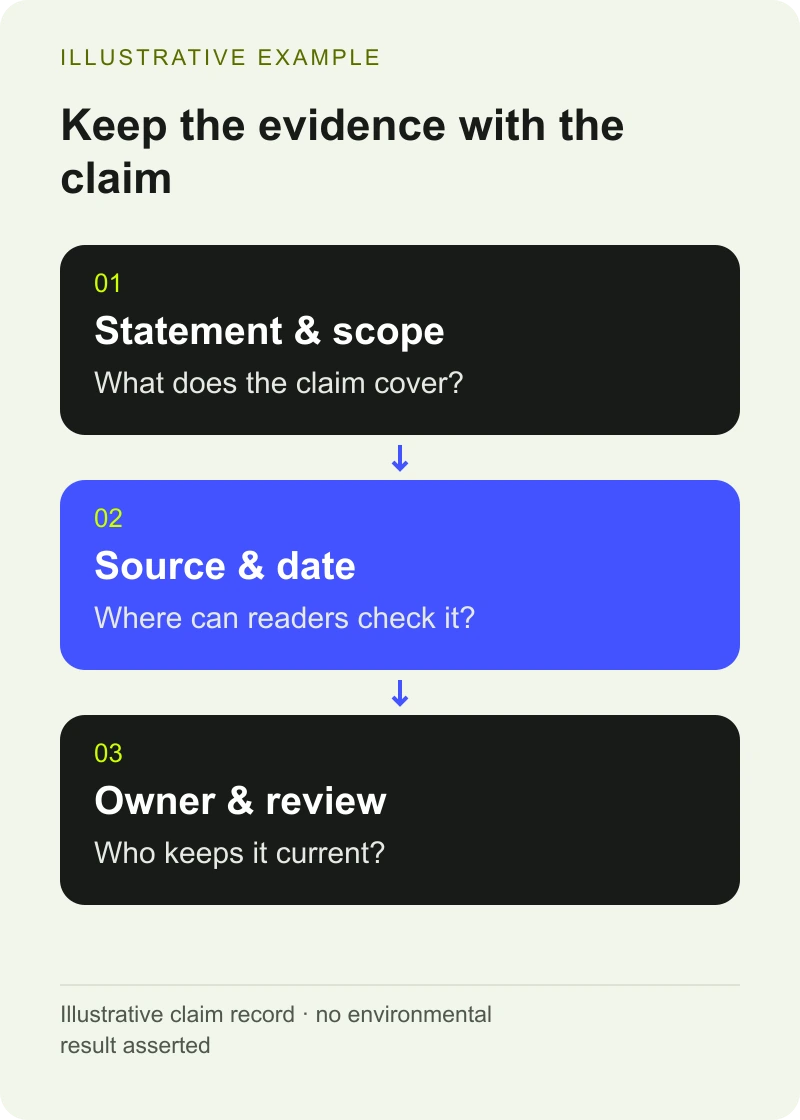
For the page itself, ask which product, activity, period and boundary the evidence covers. Record the source and the person able to explain it. If a comparison is involved, identify what is being compared and whether the basis is genuinely comparable.
Avoid adding a number because the layout needs a large statistic. If there isn’t an approved figure, explain the product or process in words. The empty space will survive.
Keep the qualifying detail where it can be read
Here’s a fictional editorial example. A team proposes “Lower your business footprint” for a feature that helps customers review one part of their purchasing. Before publishing, I’d ask whether that wording overstates what the feature does.
A clearer product explanation might say that the feature helps a team review purchasing data and identify questions for its suppliers. An environmental outcome would need its own support. Those are different statements with different jobs.
Once the wording is agreed, place the relevant scope beside it. A reader shouldn’t have to open a dense report to discover that a headline applies to a limited activity or period.
Use the supporting page for the detail: method, sources, exclusions and the version being described. The headline and supporting page should tell a consistent story at different levels of depth.
Want to apply this to your own website or app?
Tell me what you are working on and where it is getting stuck. I will help you turn the useful ideas into shipped work.
Give evidence a place in the publishing system
A claim can appear on a product page, in a campaign, inside a sales deck and in a translated version of the site. Copying it between those places makes later corrections harder to manage.
I’d keep a record of the approved wording, evidence source, owner, approval date and the pages using it. Add a review trigger. That could be a changed methodology, a new product release or the end of the period the evidence describes.
For a small team, a maintained document may be enough. If you need a structured source, an Airtable and Webflow content workflow can be scoped around the approved records. The connection is useful once the editorial decisions exist.
Think about what happens when the evidence is withdrawn. Who changes the live page? Which campaigns and translations need attention? A review date without a person responsible won’t answer those questions.
Make the detail usable without turning the page into a report
Keep the main proposition readable. Follow it with an explanation of what the product does and a visible route to the evidence. People with different questions can then choose the depth they need.
If you publish a chart, provide the information needed to understand it outside the image. W3C’s guidance on complex images explains the need for a fuller text alternative when a short description can’t carry the information. A decorative green chart with unreadable labels does very little for a buyer trying to check a claim.
For a substantial report, a web summary can explain the important finding and link to the complete method and document. Keep the dates and scope consistent across those formats.
Review the promise before adding another badge
Put the draft page in front of the person responsible for the evidence. Ask them to explain what a reader could reasonably conclude from it. Review the headline, images, labels and comparison together; the overall impression can carry a claim too.
The climate-tech website planning checklist includes claim ownership, supporting material and publishing responsibilities. It’s a useful starting point for a product page that has grown through several campaigns and needs a careful tidy-up.
Bring the current page and the sources behind its strongest statements. I’d start there before adding another paragraph about changing the world.
Frequently asked questions
Does every climate-tech product claim need a percentage?
No. Explain what the product actually does. Use a quantitative environmental outcome only when the organisation has suitable evidence and an approved account of its scope, method and limitations. A figure chosen for visual impact doesn’t help a buyer evaluate the product.
Can all the qualifying information go in a downloadable report?
Important context should be clear enough on the page for the headline to be understood accurately. A report can provide further depth. Avoid making someone download it to discover a limitation that materially changes the main promise.
Who should own claims in the CMS?
Assign someone who can approve the evidence and meaning, alongside the person who publishes the page. Keep the approved statement, source, version and review trigger together so a change can reach every place that uses it.