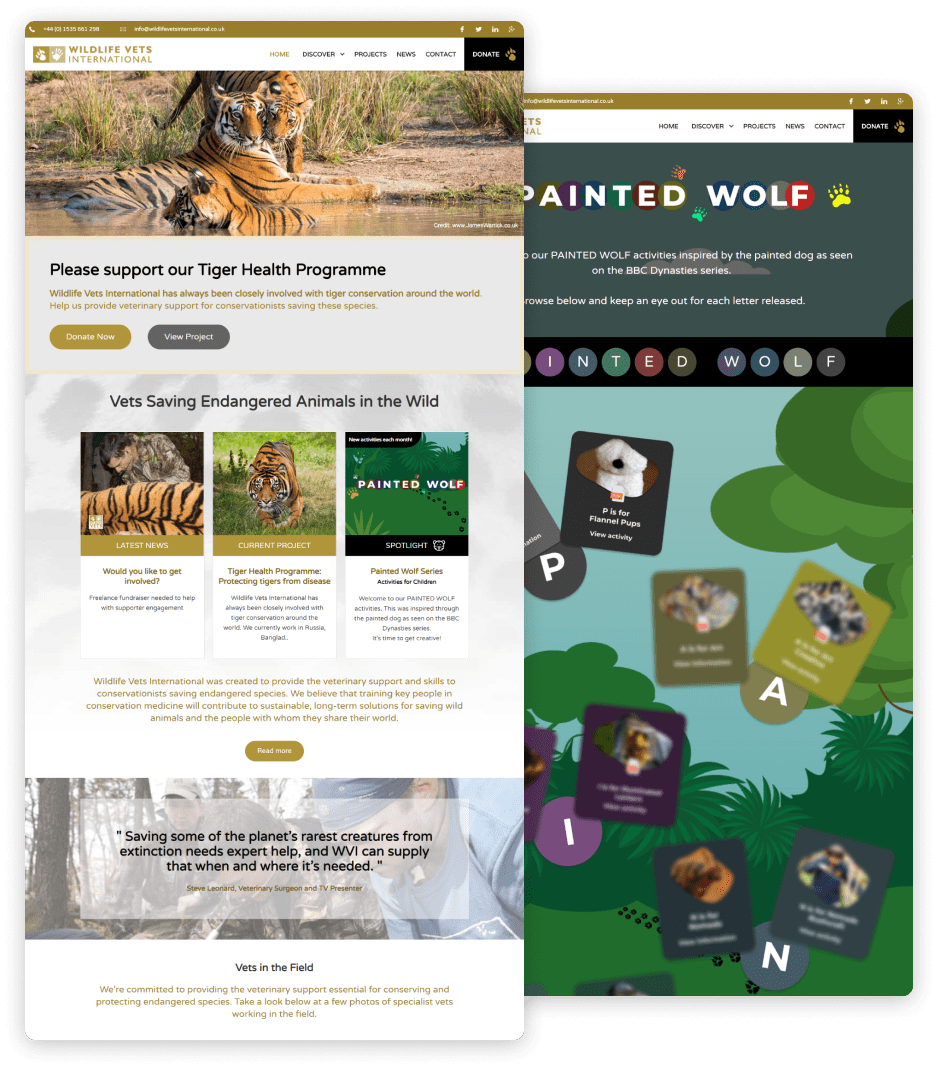
Veterinary charity with Wildlife Vets International

Veterinary charity with Wildlife Vets International
Overview

Wildlife Vets International is a British charity that has been providing critical veterinary support to international wildlife since 2004. While at Wired on Design, I led the rebuild of their outdated WordPress site as a fully migrated Webflow website.

The project involved re-creating over 60 pages, migrating the blog while preserving links and structure for SEO, and integrating a donation platform that streamlined the donor experience. The Webflow CMS gave the WVI team a much easier way to update field reports, project pages, and news without developer involvement.

Post-launch, the redesigned site delivered a 40 per cent increase in engagement, with cleaner navigation, a stronger donation pathway, and faster page performance all contributing to the result.

The Problem

Wildlife Vets International had a mission that punched well above its weight — providing critical veterinary support to wildlife conservation projects in some of the world's most fragile ecosystems. But their digital presence didn't reflect that. Their old site was difficult to update, visually inconsistent, and couldn't clearly communicate the urgency of their work to potential donors and partners.

The bigger problem was operational: the team needed a site they could manage themselves without calling a developer every time a new field project launched or a funding appeal went live. For a lean charity, that kind of bottleneck wasn't just frustrating — it was costing them donations and credibility with institutional funders who expect a professional, transparent digital presence.

The Build

I built a complete Webflow site designed around their two core audiences: individual donors who need an emotional, story-driven journey, and institutional partners who need clear impact data and project transparency. The information architecture separates these paths cleanly — the homepage leads with mission and urgency, while a structured Projects section gives each conservation programme its own page with goals, progress, and partner logos.

The CMS architecture was the real unlock. I set up modular collection structures so the team can add new projects, update impact metrics, and publish funding appeals through the Webflow Editor without touching the design layer. Every field is labelled in plain English, and I provided a short training session so they could take full ownership from day one.

Technically, the site uses Webflow's native CMS with conditional visibility for funding progress bars, a custom donation flow integrated with their existing payment processor, and a resource library for veterinary protocols that their field teams access globally. All built with accessibility as a hard requirement — WCAG 2.1 AA across every template.

The Outcome

The Wildlife Vets team now runs their entire web presence independently. New conservation projects go live in under an hour — the comms lead just fills in the CMS fields and publishes. That's the difference between a site that sits there and a site that actually works for a small, fast-moving charity.

Donation conversion improved measurably because the new site connects the ask directly to specific projects — donors see exactly which species and ecosystems their money supports. Institutional partners have told the team the site was a factor in their funding decisions, which for a charity of this size is a genuine return on investment.

From my perspective, this project reinforced something I've seen repeatedly: a well-built CMS is a force multiplier for small organisations. When the people who know the mission best can publish without friction, the story gets told faster — and that's what drives donations, partnerships, and impact.

Veterinary charity with Wildlife Vets International — website preview

Like this? Let's build yours.

Featured work